Emily Dickinson, "I had a daily Bliss"
The big questions swirl around Dickinson's time, too, and are answered in bloodshed.


Hi all –
Too many cheerleaders for the current war; truth is, too many cheerleaders for any war, but this is an exceptionally tough pill to swallow. I don't have illusions about Iran: the regime represses its people brutally, with the blood of their youth awash in the streets. Still, I don't see how starting a war and bombing elementary schools, oil refineries, and desalination plants makes anyone less paranoid or violent. I don't understand how demanding "unconditional surrender" and advancing the goals of their rivals is smart. To be sure, I can plainly see the corruption and contempt for life of certain warmongers.
Oh, the cheerleaders say, I am wrong. Deluded. I am not taking into account the simple fact Iran's rulers are evil. That many in Iran desire freedom deeply and will endure funeral after funeral in order to change their destiny. That leaves us no choice but to do everything possible to destroy a regime which helped fight ISIS, was compliant with the nuclear deal, and showed restraint in the face of other U.S. attacks.
So many people want to believe violence alone solves problems. We call the bad guys bad, eliminate them, and all is well. And so while the war is still unpopular, support for it has grown:
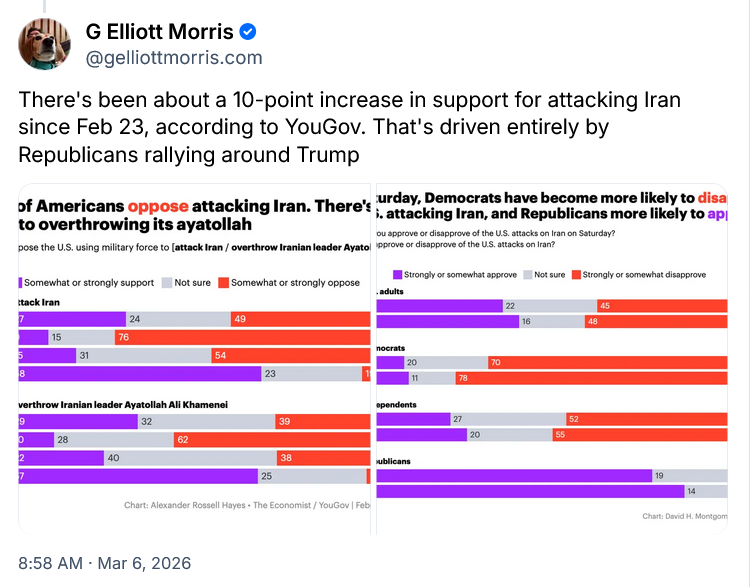
I guess this is the part where I'm supposed to outline how we fix this. I'll be real: we need anger about the war to become the capacity to frame the conversation. This starts by making clear there is a duty to question propaganda and get reliable sources. (Related: if we get away from broadcast & cable news, what does the world think of us?) Those who think they have a serious case for this war can't be allowed to say anything other than "I'm sorry. I wish I knew better before." After all, we are demonstrating how we "negotiate" and making it clear we cannot be trusted. We literally talk to someone until we can target them and then fire. Note that we have no settled explanation for why we went to war. This is completely unacceptable by a country calling itself the leader of the free world.
Jeffery Shockley, "How Jobs Work in Pennsylvania Prisons"
I hope you'll take a look at Jeffery Shockley's report about jobs in prison. What struck me were the incredibly low wages–sometimes 19 cents an hour, sometimes 42 cents–and how they sharply contrast with the skills inmates have. Shockley talks about a volunteer dog handler (yes, they're handling a dog in prison) who also has to work as a prison janitor: 23 cents an hour.
Honestly, I think I will revisit Shockley's piece to talk about work in America in general. Of course, the conditions in prison are especially vicious. I do feel his report brings out how the difficulty and dignity of work are denied by our various institutions. If you're a narcotics counselor at a jail and trying to get people to make radical changes quick, we're not empowering you. If you're dealing with tough customers while trying to make sure the poor eat, we barely recognize your existence. This extends to paramedics and nurses and teachers and a host of jobs we need for society to run. If someone has billions upon billions, that money is coming from somewhere, and the only way to justify it is to make everyone else cynical about actual work.
Emily Dickinson, "I had a daily Bliss"
I began this newsletter complaining about war, then turned to the fun topic of prison. Dickinson's first two lines, "I had a daily Bliss / I half indifferent viewed," strike me as immediate and necessary. How do we recognize our daily joys without taking them for granted? On that note, how is it possible we can almost ignore "Bliss" with a capital B?
I should back up for a moment. We are looking at an old poem from the Civil War era. The big questions swirl around Dickinson's time, too, and are answered in bloodshed. But that thought doesn't really give us access to this poem in the way we need. Nor does forcing some advice out of the poem for the sake of something like self-help. I've got to remember when commenting on any poem that I have unwittingly set up something like a museum exhibit. I have to create a conversation so we can figure out why the conversation even started. A "daily Bliss," "half indifferent viewed" is an invitation to thinking about our condition.
I had a daily Bliss
Emily Dickinson

I had a daily Bliss
I half indifferent viewed
Till sudden I perceived it stir —
It grew as I pursued

Till when around a Height
It wasted from my sight
Increased beyond my utmost scope
I learned to estimate.
Our condition merits a direct, easy answer, no? I just complained about war and mass incarceration! In those circumstances, everything is "half indifferent viewed," right? Well, not quite. Think about the people you know who are most propagandized. They really, really don't want to admit they are wrong; they are scared of humiliation far more than hurting someone else. When they go to their favorite broadcasters and podcasters, they want reinforcements. Think about those we know who are "half indifferent," if not indifferent. It isn't numbness from news of bombs and jails which afflicts them. A lot of times, they don't want to know because obligations are frightening. There's a lot of fear in this country–a number of people do not want to leave the house, not ever–and this wells up into an actively negative spirit. Not just one that is bitter or panicky, but one which wants to shut down the possibility there are uncomfortable truths.
Dickinson's lyric uses the imagery of engagement with nature. "I half indifferent viewed / Till sudden I perceived it stir – / It grew as I pursued." You could imagine her working in the garden, enjoying half-seeing a marvelous animal day after day. She didn't always see all of it, but its colors made a tree or brush it sat in much more vivid and interesting. One day, the animal moves, she comes in for a closer look, and it runs or flies away slowly then suddenly. "It wasted from my sight." This is not the indifference we are dealing with from those who in denial. Is it an indifference those of us who want a better world have?
I don't know how much I like going this direction. If you're raising money to feed or house your neighbors, I don't want to hint that there may be something you're taking for granted. These are overwhelming times. All the same, you're here because you don't want me to be dishonest. On a practical level, I do feel many of us could do a better job helping the helpers. A lot of people are giving or trying to give and need their spirits boosted. They are in the background of whatever work we are trying to accomplish–you don't change everything with one grand stroke. Change is the efforts of thousands, if not millions. On a theoretical level, the challenge is to do the work but recognize what is actually in our gardens. We might start by asking what we don't want to disturb. What are the ways we can help which don't interfere with or scare good things away?
It's funny, though. Dickinson doesn't count the "Bliss" running away as a loss. "Increased beyond my utmost scope / I learned to estimate." There was beauty, there was happiness, and she learned not to mourn but aim for what was felt. Her poem embraces the messiness of a "daily Bliss." You're out there, doing the work, or doing something, and the vibe is right. If this is good, if something is being achieved, then you don't want to replicate that good exactly when things change. You want to work with change–"estimate"–because the next thing capable of "utmost scope" will come.