Kobayashi Issa, "Yellow Autumn Moon"
The fullness of life stretches toward night.


Hi all --
Daniel Mopkins' "5 Sensory Experiences of Prison," from 2023, got me to reflect on how I'm processing the deluge of details confronting all of us at the moment. Mopkins begins with a sight most relevant to our current reality: "Sight: The cell block is all white with blue trim. Sixty men on the tier — 90% percent Black, everyone in white state-issued uniforms." In just one written observation, there it is: state violence repressing populations considered troublesome.
Mopkins' short 2023 piece can frame our current struggle. A white woman who was a poet and a white man who was a nurse are considered expendable because they dared to protect their neighbors of color. Neither party plans on shutting down our camps for children, children like Liam Ramos, even as we receive reports they are sick and dying. I'm overwhelmed with details, but the picture is clear.
For my part, I think it is important to emphasize that the opposite of American democracy is not simply tyranny, but racism. Democracy is supposed to be majoritarian rule which expands rights and opportunities for all. We should gather to hear concerns and plan to address them. Racism wants majoritarian rule in order to empower a few. As more vulnerable groups are bullied to death, the number who can oppose the regime dwindle as theft from the top proliferates. Making the country a giant prison is the goal. You'll note prisoners do a lot of work–including fighting brutal, out-of-control fires–for very little, if anything at all.
On another note, Spencer Ackerman outlined some prospects for hope in "Your Leaders Were Lying. Now The People Are Driving." I shared the article with someone and they asked me who Mr. Ackerman was. I introduced him as a Pulitzer Prize winning reporter who exposed the black sites Chicago police used for years to illegally detain and torture suspects. As well as the guy who showed us, via the Snowden revelations, that everything we say on our phones can and will be used against us. I guess I'm trying to say that if Mr. Ackerman sees what good is happening, we should pay attention. He points directly to new modes of political organization emerging organically out of necessity. We have seen–as he dutifully notes and I will paraphrase–Minnesotans gather resources for each other, keep watch and track suspicious activity, accompany those who need protection, help hide those who are rightfully scared to leave the house. We have seen them sacrifice in ways where praise must fall short. They are pressuring their leadership to do more while resisting an occupation. This is not unsophisticated; these are functions of a complex social organism:
Amidst the violence of the state, people turn to their communities. They build resilience together out of necessity. To warn each other of the advance of ICE, they array themselves into patrols and conduct reconnaissance. They make mistakes and adjust. They observe their enemy’s patterns and adjust. You can read a point-of-view account of these networks from our friends at CrimethInc. We saw this in Los Angeles, Charlotte, Chicago, Portland and probably in DC. It’s happening in New York, too, though New York has not been flooded with ICE like those cities have.
This, to use a scary term, is called anarchism. Anarchism is not chaos. It's grassroots, stateless socialism.
I don't know what comes next but I know the constitutional order I have known my whole life is done. I know what's going on with "anarchism," the "grassroots, stateless socialism," speaks to what is to come. Neighbors who stand for each other, committed to multiethnic democracy, doing work based on the needs of the community as opposed to the whims of capital–this is the only serious future.
I hope you'll read both articles, as I enjoyed them greatly. And I hope you're still contacting your elected officials, pushing to abolish ICE, and giving to worthy causes. The incarcerated can always use your help. If you want to Stand With Minnesota, I understand a number of immigrant families desperately need rent.
Kobayashi Issa, "Yellow Autumn Moon"
Issa: "Yellow autumn moon... / unimpressed the scarecrow stands / simply looking bored."
The bright moon faintly illumines the changed hues of trees, the subtle outlines of clouds, the slight motion of water. Under it bores like me simply sleep, lovers exchange knowing glances, the reverent continue praying, the addicts descend into their dens.
The fullness of life stretches toward night. The moon witnesses this, making it just visible enough. Yet Issa has us imagine a scarecrow in a field, bored with that moon, and maybe sourly looking upon everything.
Yellow Autumn Moon
Kobayashi Issa (tr. unknown)

Yellow autumn moon...
unimpressed the scarecrow stands
simply looking bored
Is the scarecrow another "old man yells at cloud" meme? A victim of an unexplainable grumpiness? A body become tired of itself? Autumn is the season where decay stands lovely and ever present. A scarecrow, a witness to growth, understands autumn as prelude to winter all too well.
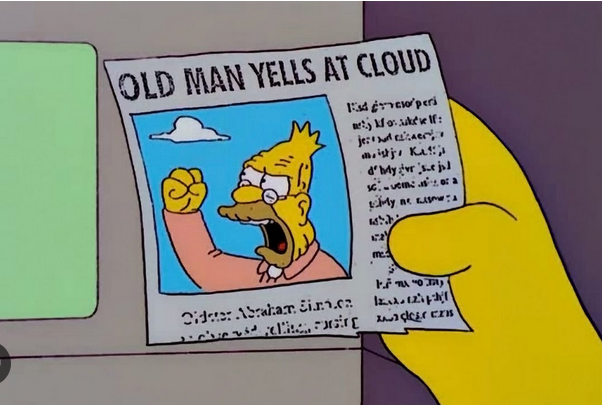
To be sure, Issa sounds impressed with the moon. But is he more impressed with the scarecrow? Not to overuse The Simpsons, but Homer's conversation with his boss, culminating in "I'm not easily impressed. Whoa! A blue car!" plays in my head on infinite loop. I feel like Issa puts himself in the position of Homer Simpson in this haiku. The scarecrow, like an aloof, indifferent, completely in charge teenage dream, is his aspiration.
In "Sailing to Byzantium," Yeats gives us the grumpiest of grumpy narrators. An old man mutters "caught in that sensual music all neglect / monuments of unaging intellect." I can never tell if we are confronted by a believer or some strange philosopher in that poem. I think we can safely say they are a scarecrow, one unimpressed by the dying world for reasons of belief or reasons purely. There is this difference: scarecrows have an obvious use. They protect crops inasmuch as they mimic humans.
Issa seems impressed with the disdainful scarecrow, the one who has seen too many moons. And I wonder if we should be impressed by towering wills and intellects which refuse to believe this world means anything. Ones who not only tire of the perishable, but never wanted to be tied to anything which dies to begin with. I'd like to say that lunatics obsessing over what lasts are trivial. But that isn't strictly true. Some beautiful things have persisted throughout the ages, and that is in part thanks to relentless creators and equally relentless preservers. I don't want to know what extremes they went to save art. I'm sure I don't want to talk to them. I do need to thank their scarecrow selves.