Lucille Clifton, "hometown / 1993"
Many, many people want to believe they possess some comfort and everyone else can, too.


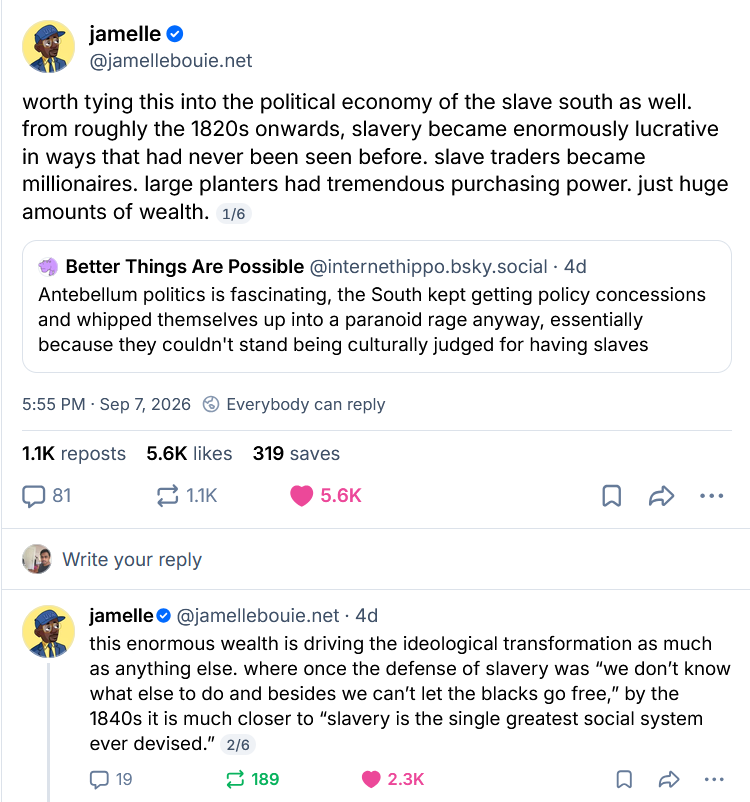
I must engage art, I tell myself. And then I don't. I skim the news and look for "takes." Some are very informative. I'll end up thinking about the incredible wealth and endless appetite of antebellum slaveowners. How this parallels our tech barons. Both groups would rather burn down the whole world than admit being wrong about anything. The slaveowners got everything they wanted–immense power in the states they controlled, a federal government making free states accomplices in slavery, new states dedicated to nothing but slavery–and it was never enough. A number of behaviors visible nowadays, esp. with regard to the fanboys of certain individuals and companies, make sense when considering the origin of the Confederacy.
Or I'll read an article about Greek tragedy. Tragedy brings us to spaces where the political and ethical are deconstructed. You're there, in the amphitheater on a torchlit night. Though there are thousands around you, no one makes a sound. They listen to every syllable of the prophet as he excoriates the king. Their love of country is suspended by a thirst for justice; for most this weirdly reinforces their belief in the ways of the city. For a few, something cracks open. I have to work through what is even meant by "political" and "ethical." The views of other scholars must be studied. Much is on the line, but I worry about a collapse into technicalities. I don't want to break my own ability to see by trying to see too much.
So here I am at the library. I'm wading through Lucille Clifton's poems, which are musical and resonant. How to think around her lines, beyond arguments and definitions? Below, she walks us through a landscape of wounds, picturing a hometown in disrepair and a family losing the struggle to survive:
hometown
1993
Lucille Clifton

think of it; the landscape
potted as if by war, think of
the weeds, the boarded buildings,
the slivers of window abandoned
in the streets, and behind one
glass, my little brother, dying.
think of how he must have
bounded into our mothers arms,
held hard to our father's swollen hand,
never looking back, glad to be gone
from the contempt, the terrible night
of buffalo.
I arrive at "hometown / 1993" in a mood. The President of the United States, known for his comments about racial minorities (see: "shithole countries"), has proclaimed he will give $5,000 to every American citizen if his party dominates the midterm elections. This is a felony, a direct violation of 18 U.S. Code §597, which prohibits "offers" of "expenditure" to a person for their vote. And here's Clifton, describing a location that looks wrecked by war. How to reconcile the reality that someone can commit crimes in public view and receive no pushback whatsoever with the reality that entire communities are not only neglected, but abused by the same system? Corruption at a structural level is deeply and viciously illogical. For example, you'll assume for a moment that we have invested in security. There are forces with nice shiny cars and neat uniforms and an assortment of weaponry. Those forces must do their job, no? Maybe their focus can be changed to help a part of town full of "weeds," "boarded buildings," "slivers of window... in the streets," and dying families. Maybe they can hold the President who is worth 6 billion dollars accountable.
Further reflection and you realize that things have been built this way. This country means to give some people 6 billion dollars and others nothing.
Some see that immediately, to be sure. They can articulate that this is what it means to have two Americas, where our systems serve perceived members of one class and attack those trying to break the cycle of poverty. But this is a hard truth to believe. Many, many people want to believe they possess some comfort and everyone else can, too. The President made it, after all. There's money to be had everywhere; opportunities abound; children dying is inconceivable. A "father's swollen hand" must be an exception. The "contempt," the "terrible night / of buffalo" should not matter. It is true that if you're doing what is right you shouldn't care what other people think.
The challenge of Clifton's words is to accept them as real. The richest country in the history of the planet indulges cruel, deadly poverty. It does so in large part through a lack of focus; nowadays, I like to say this is a fatal inability to appreciate priorities. To take a not so small and extremely relevant example: if you're a university serving a poorer population, and you drop nearly all your resources into your football team, how many of the other students will pay for that lack of focus? How many will not have access to critical supports? How many will starve?
You really have to sit with "the slivers of window abandoned / in the streets," the infamous broken windows theory which declared so many criminals for petty offenses, never bothering to make sure the poor ever had access to opportunities, resources, or advocates. Or sit with how some can be "glad to be gone," born into a world only giving or promising pain. The "takes" which promote my understanding, the papers which push me toward more precise definitions, don't always quite factor in the cost of ideas.