On Policing in America
The key statistic you need about cops is this: cops solve 2% of all major crimes.


Hi all –
Time both blurs and weighs. The last few weeks moved like a bullet train and I barely saw anything, just smudges of colors in vague shapes. I can say that preparing for a semester of American Government nowadays will cost you. Not because you have to extensively research and design modules on obscure topics, but because you must convey the grim reality we live in. The stress of knowing the stakes doesn't leave you, especially when you grew up with excessive mockery when you were right.
The peculiar weight of time resides in expectation. It will break the strongest of us. What if you try to abandon it altogether? I don't know if I can create anything good; I don't even know what opportunities may be fruitful. I have to try things, experiment, and embrace the uncertainty of my own efforts. And that uncertainty is not unreasonably loaded with self-doubt. How do I know when I am properly following through? How do I know when I'm putting forth the requisite effort? The worst thing is to not know why you're failing or succeeding, to lack control over control.
It sounds like an all-too-personal drama, one only fit for a private journal. But I'm sure that's where most of us are at the moment. Life is easier with a functioning public sphere, one where others willingly invest trust to each and all. What we have now leaves us to our own devices and wishes, and it is no wonder we are ruled by influencers with the maturity of angry, undisciplined 12 year olds. They make "content" and goad us into reacting and responding; they do this trusting that all attention is good attention. The rest of us are passive, knowing something better is out there but not sure how to invest in ourselves.
Lexie Handlang, "Prison, Like Life, Is Not Designed for the Deaf"
Lexie Handlang's short essay is about coming to terms with being deaf in prison. It stands as a stark reminder of the gruesomeness of caging people. To deal with a disability in normal circumstances can devastate the best of us. The care we are given can only help so much. But to do so in prison? To know that the system is built to deny the care you need?
I have had surgeries on my ears to remove scar tissue and remove cysts. Prior to my incarceration, my audiologist wanted me to get a bone-anchored hearing aid, a device that helps you hear through bone conductions of sound vibrations to the inner ear. Doctors have advocated for me to get a cochlear implant in prison, but the Missouri Department of Corrections will not pay for this.
It was not until recent years that my hearing loss got to the point that it is today.
I'm grateful for the tough words of this piece. It isn't easy to build community, even if others are in similar situations, even if others can teach you what you need to survive. But Lexie Handlang is trying. I'm just amazed at how much people are doing with some of the cruelest situations we have established.
On Policing (or, don't forget to do more than abolish ICE)
If you're a regular reader of this newsletter, this isn't really for you. This is meant for those who believe that law and order are the same thing as justice. Who have a brother or cousin that are genuinely good cops or prison staff. Or who think that the cops are underfunded and schools get too much money. Or that if we don't have a ton of cops, then everyone will steal from everyone else and everything will go to hell.
For those of you who believe and think such things, I'm going to ask you to throw all those ideas away. I'm not saying you shouldn't respect genuine heroes and servants, but respect them because of what they bring to the job, not the job itself. The key statistic you need about cops is this: cops solve 2% of all major crimes.
That statistic alone should annihilate all the copaganda you have absorbed throughout the years. There shouldn't be any fantasies of "we're getting the bad guys" or "if I'm a cop, my presence stops crime." You should start seeing beyond the badge and the uniform. If cops don't solve crimes, how do they keep us safe? What exactly do they do with the millions, if not billions, they have as budgets?
A reasonable inference is this: the cops are not really there to keep us safe. As a whole, they reinforce the existing social order. They keep us in line. You say "good." You think your neighbors are bums because you don't always see them go to work but they have something new you don't have. Obviously they must be stealing and be punished. Let's check in on an absolute bigot and idiot, one empowered by the existing social order, a type of person all too common nowadays:
Listen to Ben Palmer talk to this woman who wants to deport her neighbor for absolutely nothing.
You might think this sort of thing the exception–you haven't called the cops on your neighbors because they use electricity in their home!–but this is literally policing. The woman who wants her neighbor arrested, put on trial, and sent to another country for doing absolutely nothing harmful to anyone else is policing her neighbor. Keeping people in line is not simply about following rules which keep everyone safe, if it was ever about that. Keeping people in line requires terror. The law becomes a weapon and only a weapon. For a free country, where laws and rights go hand-in-hand, it is essential people are out of line in order to make their demands heard and their basic needs recognized. All the people you know who show tremendous anger to protesters must be asked one question: if you can't protest, do you have any rights? Any answer other than "without protest, you have no rights" is unserious and disqualifying.
Even before discussing how the police have been used historically, which is to protect imperial and class interests, you can see that the concept of policing is problematic. This isn't to say people shouldn't be respectful of each other or observe rules. But if you want someone with a gun to take your neighbor away for no reason, you are making up rules and asking the world to confirm to your imagination. The cops, then, serve the people who use them. There is simply no way to have a democratic society or a free country if there is constant recourse to violence workers. A fair conclusion is that yes, you need something to deal with rapists and murderers and those who won't stop hurting others. But you can't put 30-70% of a given city's budget into that, then have a sheriff's department, then have county police, have state police, have federal forces. You must defund the police. They are meant for emergencies and if you keep throwing money at them, you're saying everything is an emergency all the time. That's not true and it hurts people by drowning out every real expression of need. As Bruno J. Navarro on Bluesky noted, "defund the police means funding our society:"
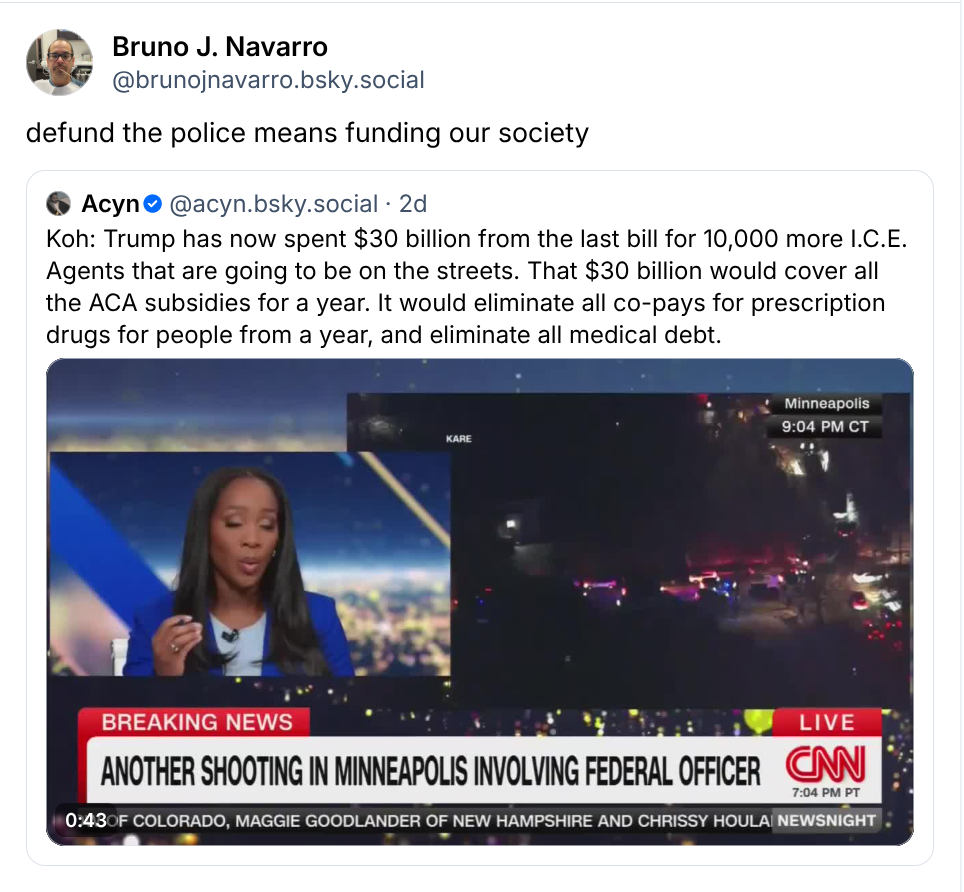
Not only do cops barely solve any crimes, but crime correlates strongly with poverty. So when you pump more money into policing and keep citizens away from proper health care, education, social services, and jobs, you create an extremely vicious cycle. People get poorer and get into trouble. The police then say there are more crimes and get more dollars. There's even less money for poverty relief and the police keep growing. Again, there's no way to reconcile this with a free society. Basic living conditions are denied so that way armed forces can have more guns. To put this in a way which should haunt you in your sleep: Texas, if considered an independent country, is the world's 8th largest economy. It has a GDP of 2-3 trillion USD. It also leads the nation in hunger. This isn't unrelated to, to take just one example, Houston spending 1 billion USD–1000 million dollars–on cops.
Some of you will say that anyone can make it in America. You just have to work! And I'll say shut up. This is a nation with a housing shortage. We have reports everywhere of people working multiple jobs and not being able to get a home as there simply aren't any. Because we don't have universal healthcare, we are not free to move jobs or create our own jobs. Many are tied to exploitative working conditions. In education, many do their best to make sure their students have everything. But the opportunities most get are by definition not those of Harvard or Yale. One can only do so much: a system designed to reward the rich and powerful will do exactly that.
Throwing millions and billions at the police practically functions as a way of silencing a serious conversation about the haves and have-nots. The richest of the rich aren't scared of justice–they know they can buy their way out of trouble. That's not an insignificant point: it tells you who the criminal justice system works for. ICE is an extension of the resentment and paranoia of the privileged. It literally serves no purpose–what does it do that another department can't do?–and has questionable jurisdiction. The courts have conceded broad power to the executive over immigration, in effect nullifying the due process clauses of the 5th and 14th amendments. All persons have due process rights, but the more you let the executive branch play with their forces and parallel courts with minimal oversight, you betray the fundamental law of the land.
The way things stand as of this writing: centrist Democrats–the so-called opposition party–are scared of the slogan "abolish ICE." They want to continue funding ICE even though it has shot a woman in the face 3 times, thrown a flashbang into a car and sent a child to the hospital, and arrested protesters and mauled observers. They are merely threatening to cut the increase in funding. What I see happening is that our elites can only conceive of power as policing. For this reason–for the reason this is fundamentally no concept of government other than authoritarianism–I urge you to consider adopting the agenda of "abolishing ICE" and "defunding the police." Yes, we know good people who are police. Imagine if they can serve their communities in ways which prevent crime and get offenders to show remorse and make restitution. The way forward is imagining an entirely different society from what has collapsed around us. What we have now is simply not functional, if it ever was.