Sappho, "I asked myself" (tr. Mary Barnard)
Our age shuns unfocused activities: we tell 14 year olds they must promptly choose a career and stick to it.


Hi all --
Before I provide some high-sounding, hopefully credible thoughts about poetry to you, we should talk about the Vice President's remarks. VP Vance said this today, December 21st, 2025, at Turning Point's AmericaFest gathering: "In the United States of America you don't have to apologize for being white anymore." Jamelle Bouie responded: "the vice president is a klansman."
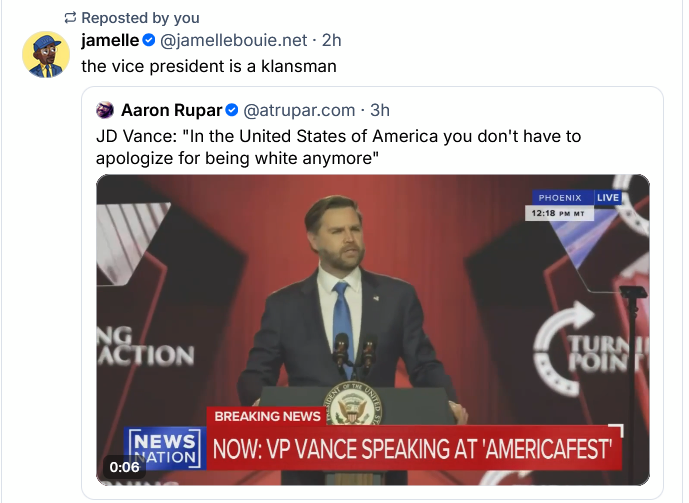
Some will argue that the VP can say whatever garbage he wants, and what's the big deal anyway? He's exaggerating his opposition to policies such as affirmative action for rhetorical effect. For my part, I encourage you to throw away that framing. The VP's choice of words was used back in the day to defend segregation. Also, consider the kind of person who genuinely believes they have to apologize for being white. I've known a few, but two examples should suffice. Both, of course, are engineers. One firmly holds that autonomous militarized drones are terrific, a future we should embrace immediately. There's not a single concern in his head about endangering public safety or drones firing missiles however they like. Another has lots of ideas about futures and crypto and not a lot of knowledge about anything else. You already know that neither of these gentlemen are ever silent.
An idiot who refuses to put themselves in another's shoes and appreciate the sheer hell they go through is dangerous enough in private life. It's a whole other game when you give them the most advanced weapons in the world, a massive domestic policing apparatus, a budget in the trillions, advisors dedicated to finding weaknesses in opponents domestic and foreign, and lawyers willing to prosecute, defend, and spin anything. To say the VP is not working to represent the American people, let alone the proposition "all men are created equal" or the spirit of the 14th Amendment, is being excessively generous. He's swimming in the fever swamps of white nationalist propaganda, believing it useful to his career. For a good example of the sort of trash influencing conservatives with power, take a look at what this Unite the Right organizer who was a professor (!) did.
I do think we have to be more upfront that there are a lot of actual, self-proclaimed Nazis in the U.S. who want to replace the Constitutional order with whatever they think an ethnostate is. They're constantly conjuring grievances in order to create cheap anger. This lets them take power in this manner: no one thinks they merit it, but their opponents have been demonized beyond recognition. So one positive response to the VP's rhetoric is to inform more people of white supremacist plots to organize and overthrow the government, and then have those people ask who exactly the VP thinks he represents.
Sappho, "I asked myself" (tr. Mary Barnard)
So far with Sappho's fragments, we've reflected on what it means to build an audience, whether we can swamp our enemies with silliness, and what the power of navigating loneliness could be.
What confronts us today continues the problem of eros: "I asked myself // What, Sappho, can / you give one who / has everything, / like Aphrodite?"
I'd like to think about this in two ways. First, a focus on gift-giving which may stand independent of anything romantic or erotic. Some people are incredible at giving, never throwing their hands in the air complaining that everyone has everything. Then I'd like to wonder at least briefly about what it means to try and placate no less than Aphrodite.
I asked myself
Sappho (tr. Mary Barnard)

I asked myself

What, Sappho, can
you give one who
has everything,
like Aphrodite?
Let's start with gift-giving. I know a few who could not be bothered in the least. Recently, I told one of them what I did for Secret Santa. How I drew someone who wanted to learn crochet, and I saw a cheap kit where you could make these decorative fruits and vegetables. The cherries looked delicious in this weird knitty way and it was $5 at Barnes and Noble after a discount. I quickly bought it and a card so they got a small gift before the big exchange. I was able to sneak the kit to them without their knowing it was me; they were pleasantly surprised by the bigger crochet kit I gave later. That featured cows. You can make these really cute, squeezable cows, and there's plenty of yarn and needles and patterns to play with.
Anyway, I tell this story and get asked why I didn't just give a gift card. Some deny gift-giving is a skill. Truth be told, it is a peculiar one. I knew someone with a real knack for giving things which led to memorable experiences. Concert tickets were a specialty of hers. She was also one of the most abrasive people I've ever met.
I don't doubt that gift-giving well entails some kind of sensitivity, but where exactly does it lie? Sappho's little lyric ties it right to love. The people who are most vocal about not caring to give make a show of their neglect. It runs so deep that they can't help but be careless with the feelings of others.
Still, this leads us to a puzzle. Aphrodite, who Sappho very much wants to please, actually does have everything. She's a god! What does giving even mean in this case? Another question suggests itself, as she is the god of love. What does it mean to truly give to a beloved? On a whim, I searched for mentions of "Emily Dickinson" and "gift." The Poetry Foundation featured prose with this rich excerpt from her letters:
By homely
gifts and
hindered Words
The human
heart is told
Of nothing –
‘Nothing’ is
the force
That renovates
the World –
"Homely gifts" and "hindered Words" tell the heart of nothing. Nothing, "the force That renovates the World." "Homely gifts" are an invitation to the far greater gift of nothing. What is Dickinson talking about? It has to be the apprehension, the freezing up when you're in love. You're romanticizing everything about them, all the "homely gifts," and you always have trouble talking, e.g. the "hindered Words." And this is ultimately nothing. This reminds me of the theme we discussed last time, where the absence of a lover was the possibilities of eros. A quiet but bittersweet optimism, you might say.
Here, the question is what you give someone who has everything. What they have is your heart; that's why they have everything. And the answer is nothing. Not so much in the sense of "hard to get," I think, but in a more practical way. Very good gift-givers gift little things which enable the recipients to play around with a variety and see different sides of themselves. I should add that there is also a larger philosophical arc. Usually, we talk about nihilism as frustration, anger, weaponized carelessness, a will to destruction eager to double down. Sappho via Dickinson is pointing to the nothingness within variety. Our age shuns unfocused activities: we tell 14 year olds they must promptly choose a career and stick to it. We're not comfortable with just making something because we can and seeing what happens. This, too, you could call nihilism of a sort: you don't know what will be produced; the order and end of creation are unclear. Some mystical traditions hold that the mind of God is nothingness.